

Wildfire Mitigation Plan Requirements by State: What Multi-State Utilities Need to Know
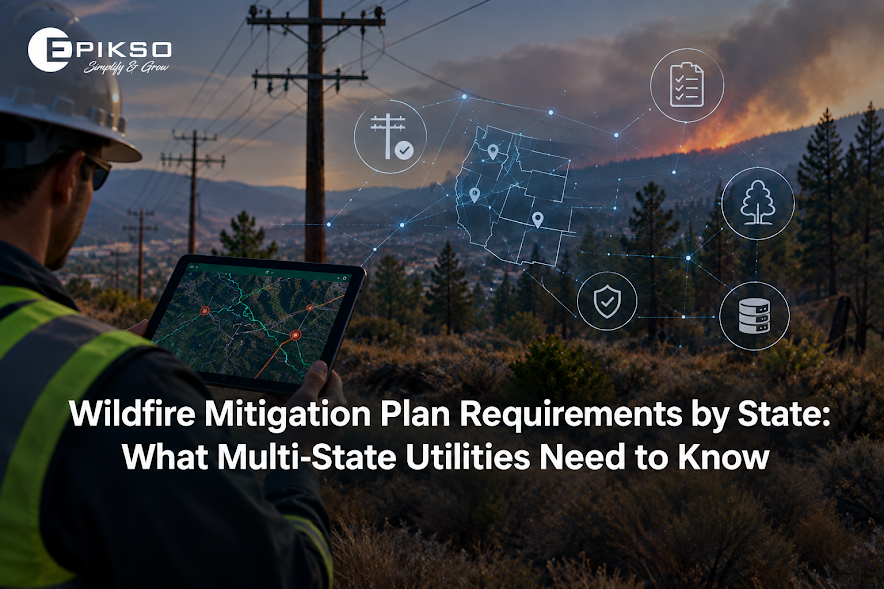
A utility can carry out the same inspection, vegetation management program or grid hardening project across two states and still have to document that work differently for each regulator.
That is becoming an increasingly important issue for utilities operating across multiple jurisdictions. Wildfire mitigation planning has expanded significantly across the West, with states including California, Oregon, Washington, Texas, Colorado, Arizona, Utah, Idaho and Nevada establishing wildfire mitigation or protection requirements for electric utilities.
The requirements are not identical. They differ in who must file, how often plans are updated, which agency reviews them and what information must be included. For utilities operating in more than one state, managing those differences can become as challenging as carrying out the underlying mitigation work.
The question is no longer simply whether a utility has a wildfire mitigation plan. It is whether the utility can consistently demonstrate that the work described in that plan was completed.
What regulators increasingly expect utilities to document
Although the terminology varies between states, several areas appear repeatedly in wildfire mitigation frameworks.
Asset inspections are a fundamental part of most programs. Utilities need processes for inspecting poles, lines, conductors and other infrastructure, particularly in areas with elevated wildfire risk. Increasingly, the important record is not simply that an inspection program exists, but that a particular asset was inspected, when it was inspected and what was found.
Vegetation management is another recurring requirement. Utilities need to demonstrate how vegetation risks are identified and addressed, including the work performed, the location of that work and, where applicable, whether required clearances were achieved.
Utilities must also document operational procedures for high-risk conditions. Depending on the jurisdiction and utility, this can include changes to operating practices, enhanced monitoring or de-energization procedures during periods of elevated wildfire risk.
Finally, emergency coordination and restoration can form part of the regulatory record. Utilities may need to demonstrate how they coordinate with emergency agencies, first responders, regulators and other stakeholders before, during and after a wildfire event.
The specific requirements vary by state, but the underlying evidence is often similar.
How wildfire mitigation requirements differ by state
One of the biggest challenges for multi-state utilities is that there is no common national filing schedule.
| State | Key consideration |
| California | Publicly owned utilities and electric cooperatives are subject to wildfire mitigation requirements under California Public Utilities Code §8387, with plans generally required on a four-year cycle after 2026. |
| Oregon | Investor-owned utilities operate under a structured WMP process, including multi-year plans, data requirements and risk-spend analysis. The PUC approved 2026–28 plans for Idaho Power, Portland General Electric and Pacific Power in June 2026. |
| Washington | Utilities operate under a state wildfire mitigation planning framework, with requirements applying to both investor-owned and consumer-owned utilities. |
| Texas | Recent rules bring electric utilities, including municipal utilities and cooperatives within the applicable scope, into a formal WMP framework. |
| Arizona | Utilities generally submit WMPs by May 1, 2026 and every even-numbered year thereafter, subject to statutory exceptions. |
| Utah | Utilities such as Rocky Mountain Power operate under wildfire protection planning requirements covering areas including risk assessment and mitigation activities. |
| Idaho | The Wildfire Standard of Care Act provides a framework for utility wildfire mitigation planning and related regulatory proceedings. |
| Nevada | Nevada’s Natural Disaster Protection Plan framework includes wildfire mitigation, infrastructure inspection, vegetation management and de-energization procedures. |
| Colorado | Colorado has established a wildfire mitigation planning and reporting framework that adds another state-specific set of requirements for utilities operating in wildfire risk areas. |
For a utility operating in one state, these differences may be manageable. For a utility operating across several states, they create a much larger coordination problem.
Why multi-state utilities face a different compliance challenge
The field operations themselves may not change dramatically between jurisdictions. A utility can have one inspection program, one vegetation management program and one GIS containing its network assets.
The reporting process is where the complexity begins.
One regulator may require information in a particular template. Another may use a different reporting cycle or request additional supporting data. Oregon, for example, has continued to emphasize modelling, transparency and supporting data in its WMP process.
This means the same field activity may eventually have to be represented in several different regulatory reports.
The problem becomes particularly apparent when someone needs to verify an individual asset. An auditor may want to see when that asset was inspected, what the inspection found, whether vegetation work was subsequently completed and how that work was reflected in the utility’s WMP reporting.
If those records sit in separate systems, staff may have to search the GIS, inspection platform, work-management system, vegetation-management records and spreadsheets before they can provide a complete answer.
The work may have been completed correctly. The difficulty is proving it efficiently and consistently.
WMP compliance is becoming an evidence-management problem
Wildfire mitigation plans create commitments. Once a utility identifies specific mitigation activities in its plan, it needs records that demonstrate what was actually done.
Those records can exist across several parts of the organization. GIS may contain the asset and location information. Field applications may contain inspection results and photographs. Work management systems may record vegetation clearing or infrastructure upgrades. Contractors may maintain additional completion records.
When those systems are disconnected, the compliance team becomes responsible for manually reconstructing the history of an asset whenever a report or regulatory review requires it.
A more sustainable approach is to maintain a consistent evidence base that connects the asset, the field activity and the resulting compliance record. The regulatory report can then be produced from that evidence according to the requirements of each jurisdiction.
What utilities can do now
For utilities operating across multiple states, a useful starting point is to compare the requirements of two of the jurisdictions with the most demanding reporting processes.
Document which assets are in scope, what inspections are required, how vegetation work must be recorded, what operational activities need supporting evidence and when each filing is due. Then trace those requirements back to the systems where the underlying information currently lives.
This exercise often reveals where manual reconciliation is taking place and where important evidence is difficult to retrieve.
The objective is not to create another compliance system. It is to establish a reliable connection between the utility’s existing GIS, field operations, work management records and regulatory reporting.
As wildfire mitigation requirements continue to develop, that connection will become increasingly important. Utilities will not only need to demonstrate that they have a plan; they will need to demonstrate that the work described in that plan was carried out and that the supporting evidence can be produced when a regulator asks for it.
How Epikso can help
Epikso helps utilities connect GIS, field and work-management data to create a more consistent evidence chain for compliance reporting.
For utilities filing wildfire mitigation plans across multiple states, this can help reduce manual reconciliation and make it easier to connect field activities to the assets and regulatory requirements they support.
If you want to understand where your WMP evidence chain currently breaks down, talk to Epikso at info@epikso.com.

Nearshoring in Mexico 2025: The Smart Move for IT and Digital Transformation
QA Automation is Helping ArcGIS Teams Reduce Field Errors and Improve Data Reliability

From Disparate Data to Decisions: How Utilities Can Finally Trust Their Reports
About Author

David Miller
Digital marketing consultant with 15+ years' experience. Primarily focused on consulting companies on their digital presence while helping them grow technology for attribution and advertising. Worked with brands and created product roadmaps, created and managed multivariate testing, performed site optimization to increase organic traffic, improved conversion rate on e-commerce sites, and created monetization plans for the largest business websites in the US.