

From Disparate Data to Decisions: How Utilities Can Finally Trust Their Reports
If you run reporting, compliance, or field operations for a utility, this probably sounds familiar: three different teams pull the “same” number and get three different answers. Compliance reporting eats up days every month, assembled by hand from a patchwork of exports. GIS, work orders, and SCADA data live in separate silos that never quite line up. And somewhere in the middle of all this, you’re also trying to migrate to ESRI’s utility data model — without losing the reporting you depend on today.
More dashboards haven’t solved this. In fact, for a lot of utility operations teams, more dashboards have just meant more places to double-check.
At Epikso, this is the exact problem our FieldOps.AI platform was built to solve.
The Real Cost of Fragmented Utility Data
Talk to enough utility operations and reporting teams and the same five pain points surface again and again:
- Information overload — hours spent assembling disconnected reports that still don’t answer the actual question being asked.
- Compliance pressure — manual, error-prone regulatory reporting with a constant, nagging fear of an audit gap.
- Disparate datasets — critical data scattered across GIS, work order systems, SCADA, and one-off spreadsheets.
- ESRI migration risk — moving to ESRI’s utility data model with no clear path to keep reporting running through the cutover.
- Workforce planning blind spots — no reliable way to forecast crew demand, balance workloads, or plan staffing against real work volumes.
The downstream cost is significant. Analysts spend days stitching spreadsheets together instead of acting on insight. Manual compliance processes leave gaps that tend to surface at the worst possible moment — during the audit itself. Decisions get made on stale, conflicting numbers. And without a forward-looking view of the work, operations stays reactive instead of proactive.
As one operations leader put it: “We can’t plan the workforce because we can’t see the work.”
Our Approach: Peeling the Onion
Rather than starting with the data and hoping a report falls out the other end, Epikso flips the order of operations. We start with the decisions you actually need to make — and work backward to the data that powers them.
1. Symptoms — Start from the reports and decisions your team actually needs, not the ones you’ve inherited.
2. Sources — Map every disparate dataset feeding each of those reports: GIS, work orders, SCADA, spreadsheets, compliance logs, asset registries.
3. Structure — Unify everything into one governed source of truth built on Snowflake.
4. Signal — Deliver automated, audit-ready insight and action, not just another dashboard.
The outcome is simple to describe, even if the engineering underneath isn’t: every report traces back to a single source of truth, so the answer is the same no matter who’s asking.
One Governed Source of Truth on Snowflake
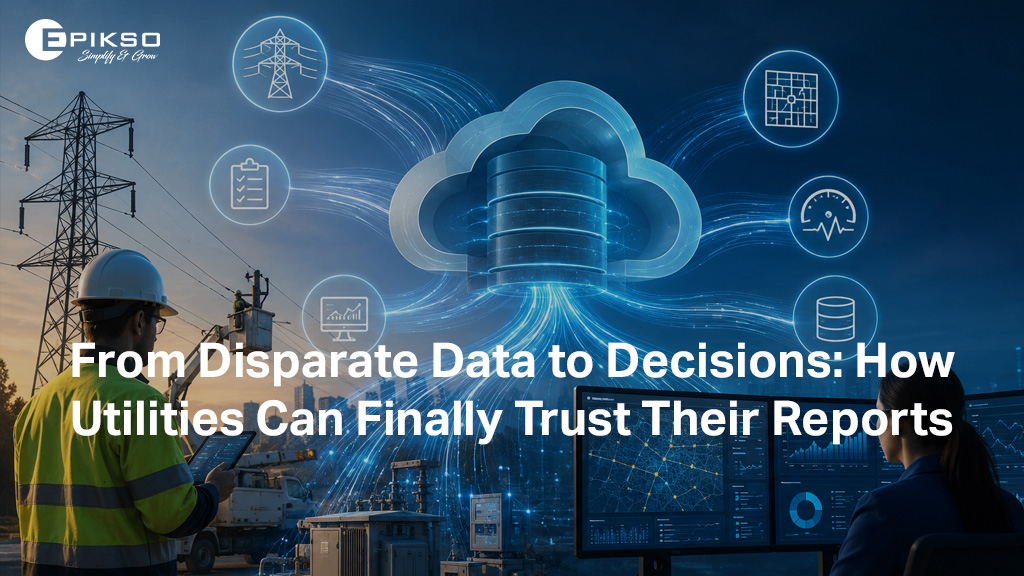
Today, utility data typically lives in six or more disconnected places — ESRI/GIS, work order systems, SCADA and sensors, spreadsheets, compliance logs, and asset registries. FieldOps.AI ingests and standardizes all of it into the Snowflake Data Cloud, where it’s:
- Ingested and standardized across every source system
- Mapped to the ESRI utility data model, so GIS stays aligned as you migrate
- Quality- and lineage-checked, so every number can be traced back to its origin
- Enriched with AI/ML, surfacing signal that manual reporting misses
From that single governed layer, FieldOps.AI generates everything your organization needs: audit-ready compliance reports, real-time operational dashboards, ESRI-aligned asset and GIS views, and workforce forecasts that plan crews and capacity based on actual work volume — not guesswork.
Compliance Reporting, Without the Monthly Scramble
Compliance is usually where fragmented data hurts the most. Today, that process typically looks like:
- Hand-built reports pulled from multiple exports
- Hours of manual assembly every reporting cycle
- No clear audit trail or data lineage
- Gaps that only get discovered during the audit itself
- Different teams producing different numbers for the same metric
With FieldOps.AI, that same process becomes:
- Reports generated automatically, on schedule
- Pulled from one governed source of truth on Snowflake
- Full data lineage attached to every figure
- Exceptions flagged before they become audit findings
- One trusted number, used consistently across the organization
Built for ESRI Migration and Workforce Planning — At the Same Time
Two of the hardest problems utility operations teams face right now are migrating to ESRI’s utility data model and planning their workforce with any real confidence. FieldOps.AI addresses both from the same unified data layer:
For ESRI migration, the platform maps legacy data to the ESRI utility model, keeps reporting running through the cutover, reconciles GIS with work order and asset data, and gives you lineage you can actually audit to validate the migration itself.
For workforce planning, the same data forecasts crew demand from real work volumes, balances workloads across regions and skill sets, surfaces backlogs and bottlenecks early, and ties staffing decisions to live operational data instead of last quarter’s spreadsheet.
The Outcomes Utility Teams Can Expect
Across FieldOps.AI deployments, Epikso has seen consistent, measurable results:
| Metric | Result |
| Source of truth | 1 — every report reconciled to a single governed data layer |
| Audit readiness | 100% — compliance reporting automated and fully traceable |
| Reporting speed | 10x faster — manual assembly replaced by automated generation |
| Team efficiency | 35% more efficient — less time stitching data, more time deciding |
| Cost reduction | 19%+ — leaner reporting and field operations overall |
| Adoption | 9+ NPS — teams that actually trust and use the platform |
(Representative of Epikso FieldOps.AI deployments; results vary by environment and scope.)
Where to Start
You don’t need a multi-year data transformation project to see value here. Epikso typically starts utilities with one of three engagements:
- A discovery workshop to map your top reports to the data behind them
- A reporting and data assessment of your current environment
- A pilot on one priority report to prove the model before scaling
The goal of that first conversation is simple: leave with a clear path from the disparate data you have today to the single source of truth your operations, compliance, and workforce planning teams all deserve.
Ready to see what FieldOps.AI could do for your utility’s reporting?
Get in touch with Epikso at info@epikso.com or visit www.epikso.com to schedule a discovery workshop.
Let’s Connect
The Future of Public Transit: How AI Is Driving Smarter, Safer, and More Sustainable Mobility
Importance of DevOps
Nearshoring in Mexico 2025: The Smart Move for IT and Digital Transformation
About Author

David Miller
Digital marketing consultant with 15+ years' experience. Primarily focused on consulting companies on their digital presence while helping them grow technology for attribution and advertising. Worked with brands and created product roadmaps, created and managed multivariate testing, performed site optimization to increase organic traffic, improved conversion rate on e-commerce sites, and created monetization plans for the largest business websites in the US.