


Revolutionizing Customer Service: The Transformative Power of AI
Introduction
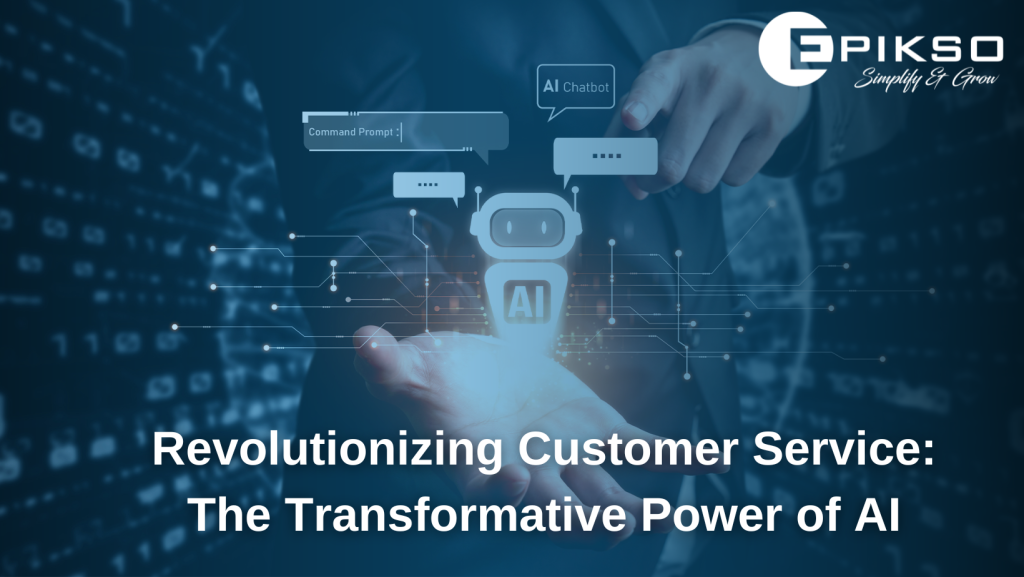
In an age of rising customer expectations, Artificial Intelligence (AI) is redefining what exceptional customer service looks like. From real-time support to predictive personalization, AI enables businesses to anticipate customer needs, improve response times, and deliver tailored experiences at scale.
At Epikso, we help companies integrate AI-powered solutions into their customer experience strategies—driving loyalty, efficiency, and measurable business impact.
This article explores how AI is transforming customer service and what organizations can do to harness its full potential.

1. Understanding Customer Needs
AI’s ability to analyze large volumes of customer data allows companies to understand preferences, behaviors, and challenges in real time.
How It Works:
Machine learning models analyze interactions, feedback, and purchase history to identify trends and predict future behavior.
Impact:
- Enables proactive outreach
- Improves product and service recommendations
- Builds deeper, insight-driven customer relationships
Reference: Smith et al. (2018) found that AI-driven analytics empower businesses to anticipate customer needs and enhance satisfaction.
2. Enhancing Response Time with Chatbots
AI-powered chatbots and virtual assistants are revolutionizing customer support efficiency. They handle high volumes of queries instantly—reducing wait times and improving accessibility.
Benefits:
- 24/7 availability
- Instant, accurate responses using natural language processing (NLP)
- Seamless escalation to human agents when needed
Reference: Gartner (2020) reports that AI chatbots can cut response times by up to 50% while improving overall satisfaction.
3. Personalized Customer Interactions
Personalization is no longer a luxury—it’s an expectation. AI allows companies to tailor every interaction using real-time behavioral and contextual data.
Examples:
- Recommending products based on browsing patterns
- Customizing responses to reflect tone and intent
- Delivering dynamic support journeys unique to each user
Reference: Li et al. (2019) show that AI-driven personalization fosters stronger brand relationships and customer retention.
4. Predictive Analytics for Proactive Support
Predictive AI enables companies to anticipate issues before they occur, shifting customer service from reactive to proactive.
Applications Include:
- Identifying potential churn risks
- Detecting service interruptions before customers report them
- Offering preemptive solutions or compensation
Reference: Provost & Fawcett (2013) highlight that predictive modeling helps organizations allocate resources efficiently while enhancing customer trust.
5. Continuous Learning and Improvement
AI continuously improves service quality by analyzing interactions and learning from outcomes. Over time, it identifies patterns that help optimize scripts, workflows, and knowledge bases.
Benefits:
- Ongoing refinement of FAQs and chatbot responses
- Improved accuracy through machine learning
- Better understanding of sentiment and intent
Reference: Chen et al. (2012) emphasize that data-driven learning cycles drive sustainable performance improvements in business analytics.
Real-World Impact

Organizations across industries are realizing measurable results through AI-powered customer support:
- 40% increase in customer satisfaction scores after automation rollout
- Up to 60% reduction in average handling time
- Improved scalability without increasing operational costs
These statistics reflect AI’s growing role in enabling customer-centric, cost-efficient service models.
Conclusion
Artificial Intelligence has become a cornerstone of modern customer service—transforming how companies connect, support, and retain customers.
By combining predictive insights, automation, and personalization, AI allows businesses to deliver exceptional service that feels both efficient and human.
At Epikso, we help organizations integrate AI strategically to elevate customer engagement, reduce costs, and ensure long-term loyalty.
It’s time to reimagine customer service—with AI at the center of every interaction.
References
- Gartner (2020). Top 10 Trends in Customer Service and Support for 2020.
- Chen, H., Chiang, R.H., & Storey, V.C. (2012). Business Intelligence and Analytics: From Big Data to Big Impact.MIS Quarterly, 36(4), 1165–1188.
- Li, X., Wang, P., & Wang, T. (2019). Personalization in Online Retailing. Information Systems and e-Business Management, 17(4), 601–646.
- Provost, F., & Fawcett, T. (2013). Data Science and Its Relationship to Big Data and Data-Driven Decision Making. Big Data, 1(1), 51–59.
- Smith, A.N., Fischer, E., & Yongjian, C. (2018). How Does Artificial Intelligence Benefit Firms? Journal of the Academy of Marketing Science, 46(4), 553–566.
Harnessing Technology and AI to Reduce Wildfire Risks: A Modern Approach to Fire Management

Enhancing Gas Utility Operations with GIS Technology

Navigating the Data Ocean: Unleashing Value with OpenSearch Service
About Author

David Miller
Digital marketing consultant with 15+ years' experience. Primarily focused on consulting companies on their digital presence while helping them grow technology for attribution and advertising. Worked with brands and created product roadmaps, created and managed multivariate testing, performed site optimization to increase organic traffic, improved conversion rate on e-commerce sites, and created monetization plans for the largest business websites in the US.